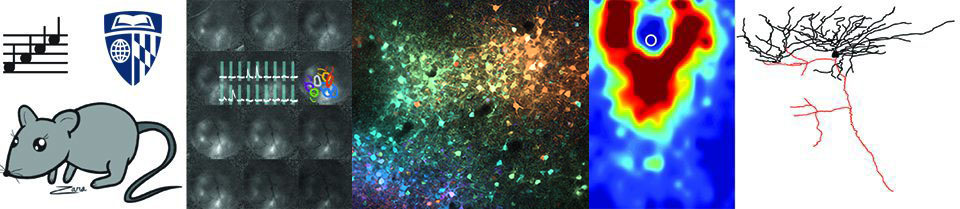
We spend a lot of time deep in the cortex. Binghan and Ying decided to look at the top of the cortex and show that in early development there are transient connections to Layer 1 cells from infragranular and subplate layers & that this connectivity depends on peripheral activity. Read more in Journal of Neuroscience here.
Author Archives: pkanold
New paper out! Impaired Hearing and Altered Subplate Circuits in Otoferlin deficient mice.
Otoferlin deficiency leads to impaired cochlear synaptic transmission and is associated with progressive hearing loss in adults. Didhiti and Ying wondered if loss of Otoferlin also had effects on cortical development. They found that spontaneous and sound-driven cortical activity in the first two postnatal weeks was impaired in Otoferlin knockout mice. Moreover, they found that in these mice subplate neurons received exuberant connections from within the cortex. Thus, otoferlin deficiency has a powerful influence on cortical connections and spontaneous activity in early development even before complete deafness. Therefore, peripheral activity has the potential to sculpt cortical structures from the earliest ages, even before hearing impairment is diagnosed. Read the full paper here in Cerebral Cortex.
Neonatal HI leads to lasting changes in L4 circuits
Aminah and Ying followed up on their last study on the effects of neonatal HI on subplate neurons (here) to see what happens to cortical circuits at later ages. Turns out these early injuries lead to persistent changes in circuit to L4 cells. Read their paper here in Cerebral Cortex.
New paper out: Aging alters population dynamics in auditory cortex
Kelson and Jonah explored what happens to sound processing as we age.
Read their cool results here: K. Shilling-Scrivo, J. Mittelstedt, P. O. Kanold , “Altered response dynamics and increased population correlation to tonal stimuli embedded in noise in aging auditory cortex”, J. Neuroscience 2021 (early release)
Early sound experience matters! It can alter subplate circuits in auditory cortex.
We knew that subplate neurons are the first cortical neurons to respond to sound. Ying and Didhiti now show in mice that altering peripheral activity can change subplate circuits in auditory cortex even before the ear canals open and before thalamus activates layer 4. Thus sensory experience can shape subplate circuits before the “traditional/classic” critical period. Read it here in Science Advances.
What is the role of transient circuits in development? New review out in Science
Many long discussions with my cherished colleagues Zoltan Molnar (Oxford University) and Heiko Luhmann (Gutenberg University Mainz) about transient circuits in development resulted in a joint review where we distill our thoughts. Read it here in Science: “Transient cortical circuits match spontaneous and sensory-driven activity during development“
Booting up
The new lab is coming to life. The paint is dry, ethernet ports are active, air tables are installed, most lasers are on the tables, and the microscopes are not too far behind. Stay tuned….
We are moving to JHU
The Kanold lab is moving to Johns Hopkins University later this spring. We will be in the Department of Biomedical Engineering. Visit us in the beautiful Miller Research Building, just down the hall from the Daily Grind coffee shop.
What happens to hearing if you don’t see?
The developmental story of L2/3 circuits: through hyperconnectivity to sparsity
Big team effort lead by Ying to track the functional development of L2/3 circuits and in vivo activity in A1. Turns out there is substantial transient functional hyperconnectivity esp. from subgranular layers paired with increased pairwise correlations during the critical period. Maybe these connections play a role in plasticity during the critical period? Read the whole story here in Cerebral Cortex.

You must be logged in to post a comment.