How do we become who we are? How is our environment and our sensory & social experience shaping our perception of the world?
We are a multidisciplinary group of scientists working to reveal how the brain works, develops, and changes with age and life experience. Because hearing is a key sense underlying both human and animal communication, we are mostly studying the auditory system.
Clinical Relevance: Our work will help to understand neurodevelopmental disorders and changes with aging. Thus, our work will aid in developing therapies to remedy altered development (e.g. from congenital deafness or prenatal injuries) that can result in impaired brain function. Our work will also inform preventative approaches to forestall some of the consequences of aging, e.g. age-related hearing loss (presbycusis) which can contribute to dementia.
We are in the Biomedical Engineering Department and part of the Kavli Neuroscience Discovery Institute.
How do we start to hear and how does experience and aging change our ability to hear throughout life?
To answer these questions we study the function, assembly, and plasticity of neuronal circuits across life
Brains are uniquely adapted to solve quintessential survival problems that face an individual in its daily life. Thus, our brains must both accurately represent (encode) stimuli in the outside world and use that representation to generate appropriate behavioral actions. The sensory representation of the environment is established during early development and is further shaped by early life experience (e.g. being exposed to your mothers voice and later by others communicating in your native language). Therefore our research focuses on understanding how our experience of and interaction with the world shapes our brains and thus who we are.
Since the human brain is a very complex neuronal circuit we are investigating key questions on a circuit level: how does this circuit work, how does it wire up during development, and how is our experience of the world shaping this process?
Because speech is important for us humans, we focus on the auditory system and the effects of hearing impairments.
How? To begin to answer these questions we investigate the circuits present in the developing and adult brain, their function, and their influence of brain development and plasticity. One focus is on probing the response of the brain to sensory stimuli and the other is to analyze the function of small sub-circuits in great detail. We are particularly interested in circuits that underlie the formation of the functional architecture of the sensory cortex and circuits underlying plasticity in both the very young (fetal and neonatal) and adult brain. We hope that insight into these mechanisms allows the development of effective treatments to restore brain function after insults or to prevent detrimental changes with aging.
We are addressing most of our questions by studies in the auditory cortex and also frontal cortical areas using many different in vivo and in vitro approaches such as patch clamp recordings, in vivo 2-photon Ca imaging, in vivo optical stimulation, multi-electrode recordings, laser-scanning photostimulation etc.. Our work is supported by the NIH (NIDCD , NEI, BRAIN initiative) and AFOSR. We collaborate with many labs worldwide.
A more detailed description of the various research directions is found here. The Kavli foundation also featured our work.
If you are interested in joining, see opportunities here.
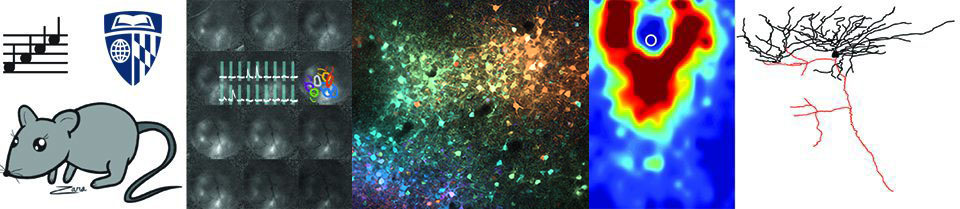
Research images above from our publications.
 The Kanold laboratory