Sensory experience even early in life can shape our brains. For example newborns can recognize their mother’s voice and many parents play music to their infants trying to induce the ‘Mozart effect’. But how does such early sensory experience sculpt the brain? What circuits does experience act on? And why is the effect of this kin d of experience seemingly more powerful in early development than later in life?
To start answering these questions we haver to first identify what neuronal circuits are present in the young brain, evaluate the function of each circuit, and test how experience acts on each circuit.
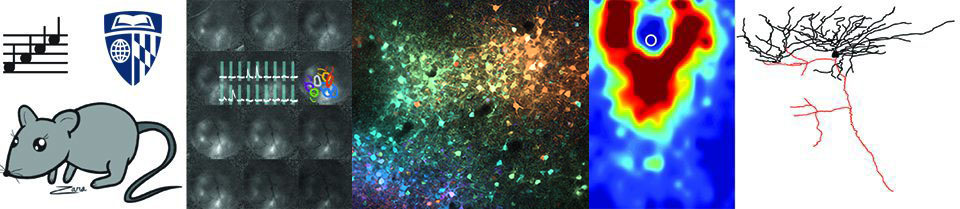
It turns out that the young brain is structurally different from the adult brain (Chang and Kanold 2021). For example before and during the critical period a transient neuronal circuit is present in cortex. This circuit is formed by subplate neurons (reviewed in Kanold 2009, Kanold and Luhmann 2010, Kanold 2019, Kanold et al. 2019, Molnar, Luhmann, Kanold 2020). Subplate neurons were first described by Kostovic and Molliver (obituary) at JHU in 1974 and turn out to be among the first generated neurons in the cortex. Oddly, and in contrast to other cortical neurons, most subplate neurons disappear over development (Kostovic and Rakic 1984, Kostovic and Rakic 1990, Luskin and Shatz 1985). However, in early development subplate neurons receive thalamic as well as cortical inputs and our work shows that they provide excitatory input to cortical layer 4 (see figure), the ultimate target of thalamic fibers (Hermann & Shatz 1994, Friauf & Shatz 1990, Friauf & Shatz 1991, Zhao, Kao, Kanold, 2009; Viswanathan et al. 2016, Deng et al. 2017). Thus, subplate neurons form a crucial relay of thalamic activity. We recently showed that these early thalamic connection transmit sensory information by showing that subplate neurons respond to sound stimuli before layer 4 is activated (Wess et al, 2017). We also showed that a nascent topographic organization is present within subplate (Wess et al, 2017). Thus, there is an early ‘proto-organizational’ period where a rough sketch of cortical organization is slayed out in subplate. Where would such a template of the future cortical organization come from? It turns out maybe from the subplate (Meng et al. 2021)!

Because after the critical period – when subplate neurons are no longer present – only limited plasticity is present, it is possible that this circuit participates in types of synaptic plasticity that occur only during the critical period. Thus, the disappearance, or remodeling, of this circuit might trigger the end of the the critical period.
Our previous work and the work of others showed that loss of subplate neurons during development leads to severe developmental malformations. Without subplate the topographically pattered connections between thalamus and layer 4 do not develop (Ghosh et al. 1992, Kanold et al., Science 2003, Tolner et al 2012). Our work points to functional deficits underlying these anatomical malformations. Without subplate neurons the connection between thalamus and layer 4 as well as inhibitory transmission within layer 4 do not mature (Kanold et al., Science 2003, Kanold & Shatz Neuron 2006, Tolner et al 2012). The result is that layer 4 is not driven by thalamic inputs. Given that neural activity is required for synaptic strengthening these functional defects are consistent with the observed anatomical deficits after subplate lesions. Thus one role of subplate is to act as a “teacher” helping thalamic inputs to connect to their targets in layer 4. We recently showed that changing peripheral inputs( by using genetic deafness models or sound exposures and deprivations) can alter subplate circuits before thalamic fibers activate layer 4 (Meng et al. 2021, Mukherjee et al. 2021). This means that subplate neurons seem to be the first substrate of experience dependent changes in the cortex. This is important as most prior studies of experience dependent plasticity timed sensory manipulations based on events in layer 4 and thus have changed experience too late to alter subplate neurons.
Our current work focuses on further revealing these early circuits and on elucidating how these early circuits shape the functional organization of the brain and control the critical period (Zhao et al. 2009, Viswanathan et al 2012, Meng et al 2014, Deng et al. 2017), Meng et al. 2021, Mukherjee et al. 2021), and how early sensory experience sculpts or constrains later wiring.
To accomplish our goals we use a multi-faceted approach utilizing neurophysiological (electrophysiology and imaging) and molecular techniques as well as computer simulations of the behavior of single neurons and neuronal networks.
Clinical relevance
Subplate neurons are present in the human cortex. In fact, in the second trimester a large fraction of cortex is occupied by subplate neurons! Subplate neurons are highly susceptible to injury, especially in the womb. Short episodes of hypoxia (such as occurring during birth!) can selectively damage subplate neurons (see here), and we show that even “mild” injuries cause altered subplate circuits (Sheikh, Meng et al. 2018). Such hypoxic episodes in humans are thought to be related to the development of cerebral palsy and other disabilities. Similarly our work showed that fetal exposure to VPA, which is linked to the autism in humans (review1, review2, review3), results in altered circuits to subplate neurons in neonatal animals (Nagode et al. 2017). Thus, changes in the subplate circuitry and neurodevelopment disorders seem to be linked, but to figure out the details will take a lot of work.
Moreover, since subplate neurons are the first neurons to respond to sensory stimuli (Wess et al. 2017), changes in subplate circuits would result in changed sensory processing and such changes could be used diagnostically. Thus, learning more about the subplate and its function is important in understanding the origin of neurodevelopmental diseases (Kanold et al. 2019, Molnar, Luhmann Kanold 2020).
Relevant publications:
M. Chang*, Z. Xu*, S. Nehs, Y. Chen, J. P-Y. Kao, P O Kanold“Specific functional connectivity of molecular subtypes of subplate and layer 6b neurons” J Neuroscience 2025
SJ Kim, T A. Babola, K Lee, C J. Matney, A C. Spiegel, M H. Liew, E M. Schulteis, A E. Coye, M Proskurin, H Kang, J A.Kim, M Chevee, K Lee, P O. Kanold, L A. Goff, J Kim, S P Brown, “A consensus definition for deep layer 6 excitatory neurons in mouse neocortex”, Cell Reports 2025, bioRxiv 2024
M. Chang, S. Nehs, Z. Xu, P. O. Kanold , “Distinct distribution of subplate neuron subtypes between the sensory cortices during the early postnatal period”, J Comparative Neurology 2024
D. Mukherjee, B. Xue, C-T Chen, M. Chang, J P-Y. Kao, P O. Kanold, “Early retinal deprivation crossmodally alters nascent subplate circuits and activity in the auditory cortex during the precritical period”, Cerebral Cortex 2023, preprint in bioRxiv 2023
D. Mukherjee, P. O. Kanold , “Changing subplate circuits: Early activity dependent circuit plasticity”, Front. Cell. Neurosci. 2023
H. Luhmann, P. O. Kanold , Z. Molnar, S. Vanhatalo “Early brain activity: translations between bedside and laboratory”, Progress in Neurobiology 2022
B. Xue, X. Meng, Y. Xu, J.P-Y Kao, P. O. Kanold , “Transient coupling between infragranular and subplate layers to Layer 1 neurons before ear opening and throughout the critical period depends on peripheral activity”, J. Neuroscience 2022, preprint in bioRxiv 2020
D. Mukherjee*, X. Meng*, J.P-Y Kao, P. O. Kanold , “Impaired Hearing and Altered Subplate Circuits During the First and Second Postnatal Weeks of Otoferlin-Deficient Mice”, Cerebral Cortex 2021
A. Sheikh*, X. Meng*, J.P-Y Kao, P. O. Kanold , “Neonatal Hypoxia-Ischemia Causes Persistent Intracortical Circuit Changes in Layer 4 of Rat Auditory Cortex”, Cerebral Cortex 2021
M. Chang, P.O. Kanold, “Development of Auditory Cortex Circuits”, JARO 2021
X. Meng*, D. Mukherjee*, J.P-Y Kao, P.O. Kanold, “Early peripheral activity alters nascent subplate circuits in the auditory cortex” Science Advances 2021
Z. Molnar, H. Luhmann, P.O. Kanold, “Transient cortical circuits match spontaneous and sensory-driven activity during development”, Science 2020; full free paper here: Abstract 2020, Full Text, Reprint PDF
P. O. Kanold, R. Deng, X. Meng, “The integrative role of Silent Synapses on Subplate Neurons in Cortical Development and Dysfunction” Frontiers in Neuroanatomy 2019
P. O. Kanold, “The first cortical circuits: Subplate neurons lead the way and shape cortical organization” Neuroforum 2019
A. Hoerder-Suabedissen, S. Hayashi, L. Upton, Z. Nolan, D. Casas-Torremocha, E. Grant, S. Viswanathan, P. O. Kanold, F. Clasca, Y. Kim, Z. Molnár “Subset of Cortical Layer 6b Neurons Selectively Innervates Higher Order Thalamic Nuclei in Mice” Cerebral Cortex 2018
A. Sheikh*, X. Meng*, J. Liu, A. Mikhailova, JPY. Kao, P. S. McQuillen, P. O. Kanold, “Neonatal Hypoxia-Ischemia Causes Functional Circuit Changes in Subplate Neurons”, Cerebral Cortex 2018 (Aminah’s Cover)
J.M. Wess, A.Isaiah, P.W. Watkins, P. O. Kanold, “Subplate neurons are the first cortical neurons to respond to sensory stimuli”, Proceedings of the National Academy of Sciences 2017
D. Nagode, X. Meng, D. Winkowski, E. Smith, H. Khan-Tareen, V. Kareddy, J.P.Y. Kao, P.O. Kanold ”Abnormal development of the earliest cortical circuits in a mouse model of autism spectrum disorder”, Cell Reports, 18(5):1100-1108, 2017.
S. Viswanathan, A. Sheikh, L. Looger, P.O. Kanold, “Molecularly Defined Subplate Neurons Project Both to Thalamocortical Recipient Layers and Thalamus”, Cerebral Cortex 2016
X. Meng, JPY. Kao, P.O. Kanold,”Differential signaling to subplate neurons by spatially specific silent synapses in developing auditory cortex”, Journal of Neuroscience 2014
S. Viswanathan, S. Bandyopadhyay, JPY. Kao, P.O. Kanold,”Changing microcircuits in the subplate of the developing cortex”, Journal of Neuroscience 2012
E. Tolner*, A. Sheikh*, A. Yukin, K. Kaila, P.O. Kanold,”Subplate neurons promote spindle bursts and thalamocortical patterning in the neonatal rat somatosensory cortex”, Journal of Neuroscience 2012
P.O. Kanold, H. J. Luhmann, “The subplate and early cortical circuits”, Annual Review of Neuroscience 2010
C. Zhao, JPY Kao, P.O. Kanold,”Functional microcircuits in neonatal cortex connect thalamus and layer 4″, Journal of Neuroscience, 29(49):15479-88, 2009.
P.O. Kanold, “Subplate neurons: crucial regulators of cortical development and plasticity”, Frontiers in Neuroanatomy, 3:16, 2009
P.O. Kanold, C.J. Shatz, “Subplate Neurons Regulate Maturation of Cortical Inhibition and Outcome of Ocular Dominance Plasticity”, Neuron 2006
P.O. Kanold ” Transient microcircuits formed by subplate neurons and their role in functional development of thalamocortical connection “, Neuroreport, 2004
P.O. Kanold, P. Kara, R.C. Reid, C.J. Shatz, ” Role of Subplate Neurons in Functional Maturation of Visual Cortical Columns “, Science 2003, see also Arber, S TINS 2004, and HMS Focus article

