Age-related hearing loss (presbycusis) affects one-third of the world’s population. One hallmark of presbycusis is difficulty hearing in noisy environments, like making out somebodies voice in a crowded restaurant or bar.
A lot focus has been placed on age-related changes to the inner ear, less is known about the age-related changes in the brain that affect auditory processing. A few years ago we started to study how age changes the processing of sound information in the auditory cortex and what the underlying circuit changes. The long-term goal is to figure out if prevent or reverse such changes and preserve normal hearing.
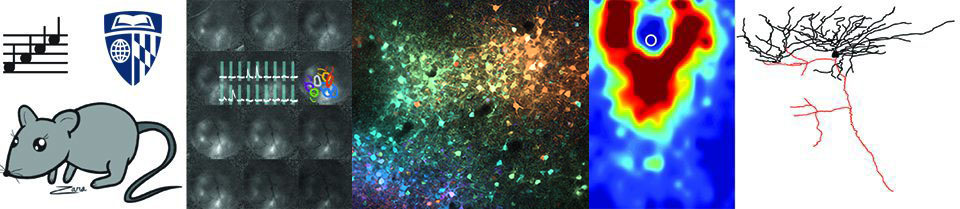
So far our work in mice has shown that auditory cortex contains distinct subpopulations of excitatory neurons that preferentially encode different stimulus features and that aging selectively reduces certain subpopulations. We also found that aging increases correlated activity between neurons and thereby causes defecits in sound encoding (Shilling-Scrivo et al. 2021). We then trained mice to detect tones in noise and found that aging reduces the ability to suppress its responses to background noise. This excess activity additionally leads to increased correlations between neurons, reducing the amount of relevant stimulus information in the auditory cortex (Shilling-Scrivo et al. 2022, JHU news).
We then investigated the underlying circuit changes in a mouse model of presbycusis (C57Bl/6 mice) and find that presbycusis changes specific excitatory and inhibitory cortical circuits (Xue et al. 2023). However, changes in the auditory cortex also occur in sex-specific way in aging CBA mice that do not suffer from peripheral hair cell loss (Xu et al. 2025). Thus, besides peripheral hair cell loss, aging has also distinct effects on the central nervous system, esp. the cortex, and that this might differ between males and females.
Clinical Relevance
While we cannot get younger it might be possible to slow age-related changes, especially those occurring in the cortex. Because of the marked plasticity of the brain we investigated if engaging in a low effort auditory task can prevent some of the age-related changes in hearing. We trained mice in automated training chambers for >6 months and found that these animals retained many aspects of youthful hearing. Thus, being engaged in auditory tasks seems to forestall many changes with aging (Mittelstadt et al. 2024). Moreover, our experiments also show that temporary visual deprivation can prevent some of the age-related hearing loss (Jendrichovsky et al. 2025). Thus, together our results suggest that long duration, low-effort auditory training, possibly coupled with visual deprivation, might be a promising easy to implement therapeutic strategy to prevent the central hearing loss with aging. Since hearing loss is linked with dementia (JHU news, JAMA, JAMA), such training might also be promising to reduce the incidence of dementia by preserving hearing abilities in the aged.
Relevant publications:
J. Mittelstadt, K. Shilling-Scrivo, “Aging in the Primary Auditory Cortex”, P.O. Kanold, JARO 2025
K. Maximov, P. O. Kanold, “Aging reduces excitatory bandwidth, alters spectral tuning curve diversity, and reduces sideband inhibition in L2/3 of primary auditory cortex” bioRxiv 2025
Z. Xu, B. Xue, J.P-Y Kao, P. O. Kanold , “Sex-specific age-related changes in excitatory and inhibitory intracortical circuits in mouse primary auditory cortex”, eNeuro 2025, preprint in bioRxiv 2022
P. Jendrichovsky, H-K Lee, P. O. Kanold, “Brief periods of visual deprivation in adults increase performance on auditory tasks”, iScience 2024, preprint in bioRxiv 2024
J. Mittelstadt, K. Shilling-Scrivo, P. O. Kanold , “Long-term training alters response dynamics in the aging auditory cortex”, Hearing Research, 2024
B. Xue, X. Meng, J.P-Y Kao, P. O. Kanold , “Age-related changes in excitatory and inhibitory intra-cortical circuits in auditory cortex of C57Bl/6 mice” Hearing Research 2023
K. Shilling-Scrivo, J. Mittelstadt, P. O. Kanold , “Decreased modulation of population correlations in auditory cortex is associated with decreased auditory detection performance in old mice”, J. Neuroscience 2022
K. Shilling-Scrivo*, J. Mittelstadt*, P. O. Kanold , “Altered response dynamics and increased population correlation to tonal stimuli embedded in noise in aging auditory cortex”, J. Neuroscience 2021
